
From Tickbox to Impact: How to ensure your compliance training doesn’t suck

Note: This is a summary of a talk I gave at the November 2025 HR Summit in Melbourne.

Do you have a least favourite compliance training?
I do. In my first week on a new job, they gave me a second-hand laptop and sent me into a pokey little windowless storage room full of broken furniture to do some H&S eLearning.
The eLearning was long and boring and one section on ergonomics patronisingly instructed me to adjust the levers on my office chair.
Not only did I feel like I was being taught to suck eggs, but the real problem was that my chair, and all the others in the room, didn’t have any levers to adjust. They had broken off sometime in their long and traumatic existences.
After reporting to the eLearn that I was unsuccessful, it advised me to contact my manager to rectify the situation.
However, I had two managers at the time; one in a different country and the other in a different cost centre which meant neither of them were really interested in my chair problem.
So what did I do? I lied. Grudgingly, I lied to the eLearning in order to proceed but it didn’t matter anyway because the module crashed shortly thereafter.
I never finished that training. And I’m sure I’m not alone.
Many of us have a horror story about boring, irrelevant, or condescending compliance training. Whether it’s an eLearning, a face-to-face workshop, or something else, compliance training often feels like something we suffer through rather than learn from.
Some of us have even been involved in creating these types of training (yes, guilty as charged!) but it doesn’t have to be this way. Here’s how it goes wrong and how to fix it.
Three Ways Compliance Training goes Wrong
It’s Not Fit for Purpose
We often rush to publish something, anything, so we can tick the compliance box. But if a training module isn’t actually preparing our people to behave safely, legally or ethically on the job, it may not hold up in court.
Take a 2023 Fair Work Commission case where an employee was dismissed for sexual harassment. The dismissal was overturned because the company’s training was ruled “unfit for purpose”. The training was described as having “all the hallmarks of a ‘tick and flick’ exercise designed to demonstrate compliance” rather than meaningfully educate employees.
The Commission said a proper, culturally and linguistically appropriate, interactive training could have prevented the issue.
In short: poorly designed compliance training doesn’t just waste time, it increases your legal risk.
It’s an Information Dump
Training sometimes starts with a big pile of documents, policies, legislation or SOPs that get crammed into a PowerPoint or eLearning module.
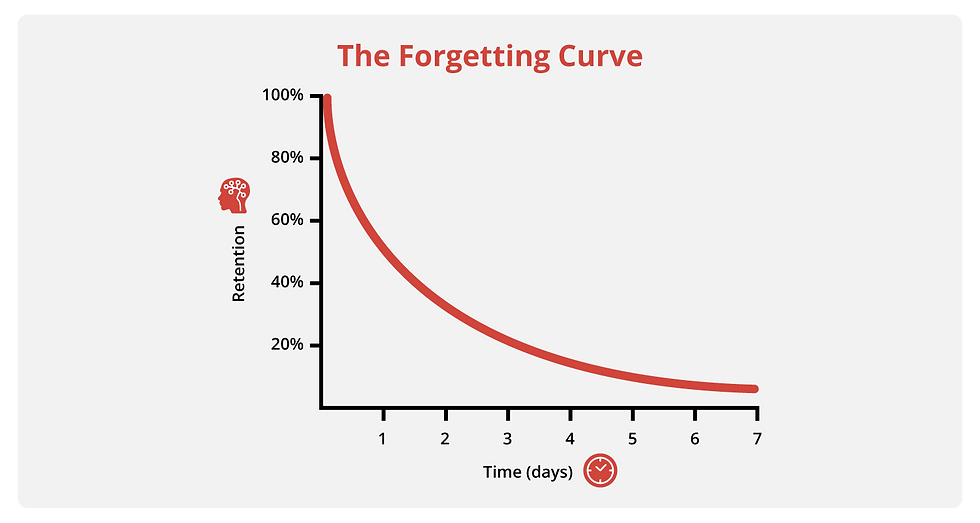
The result? Wall-to-wall text. Learners are overwhelmed and disengaged. And they forget most of it. Literally.
Without reinforcement, people retain less than 30% of what they learn in eLearning by the next day. It’s called the “forgetting curve” and it means that “one and done” compliance training often fails to stick.
It’s Too Easy
Questions like “Receiving bribes is unacceptable: True or False?” don’t help anyone. Real-life situations are nuanced. The decision to accept a gift, for example, depends on timing, value, intent and context.

Simplistic questions don’t build decision-making skills or critical thinking and they certainly don’t prepare staff to navigate grey areas on the job.
How to fix it? Here’s five ways:
Start with the Business Goal
Don't start with “people need to complete the training.” Instead, ask: What should this training change?
For example:
Eliminate unauthorised data sharing
Cut admin errors by 60%
Reduce complaint escalations to <12 per week
When you define the business outcome, you can design training that makes a measurable impact and report real success to your stakeholders afterwards.
Focus on Behaviour Change
Instead of “what do they need to know?”, ask “what do they need to do?”
This shift avoids the info dump. Using methods like Cathy Moore’s Action Mapping, you can design training around real behaviours that reduce risk, like declaring conflicts of interest or de-escalating customer complaints, rather than just summarising policies.

Use Realistic Scenarios
Scenarios help people apply knowledge in context. For a large energy company, we built compliance training around the type of gift-giving scenarios that were most likely to occur to occur:

e.g. "You're working on the next project and getting quotes from contractors. One contractor sends you a gift basket full of goodies and a Rolex watch to thank you for considering them. What do you do?"
Accept and share the gift basket with your team. Keep the watch for yourself.
Accept it all and keep it to yourself.
Accept and share the gift basket. Politely refuse the watch.
Politely refuse.
After the learner's make their choice, the next question asks them " Why?" they made that selection. By making the learner justify their choice, we’re helping them use critical thinking and decision-making skills, a big step up from your typical "bribes are bad: true/false?" question.
Research backs this: scenario-based learning makes learners 60% more likely to apply skills on the job.
Show Real-World Consequences
Instead of “That’s incorrect. Try again,” let people feel the outcomes.
e.g. When designing de-escalation training for front-line staff in a government agency, we used voice actors to simulate angry callers. If learners responded in ways that escalated the situation, the callers yelled, swore and kicked off - just like in real life. It captured the learners' attention. It felt real. It worked.

People learn best by experiencing consequences and reflecting on them. Build that into your training.
Reinforce and Measure
One-and-done training doesn’t cut it.
Working with a bank, I designed training to help frontline staff detect and report scams. The training included monthly follow-up workshops to build habits. Result? More scams were reported in two weeks following the training than the previous year. One branch staff member even prevented a $45,000 money laundering attempt.
That’s the power of reinforcing behaviour-focused training. Spacing out skills practice over time interrupts the forgetting curve and helps learners commit training to long-term memory.

Final thoughts
Of course, it’s 2025- so yes, AI is changing the game when it comes to designing and developing compliance training.
However, don't just use AI tools to take boring content and wrap it in something flashy. Our people don't need another eLearning with a flashy interface and a state-of-the-art AI avatar teaching them how to adjust their broken chairs.
Instead, if you start with the right design and the right technology, you can focus your learning solutions on achieving results that really matter. And move your compliance training from ticking the box to having a real impact on organisational goals.
Download the summary handout
Click below to download the summary handout, including other links to helpful resources and example training to make your compliance training not suck!


